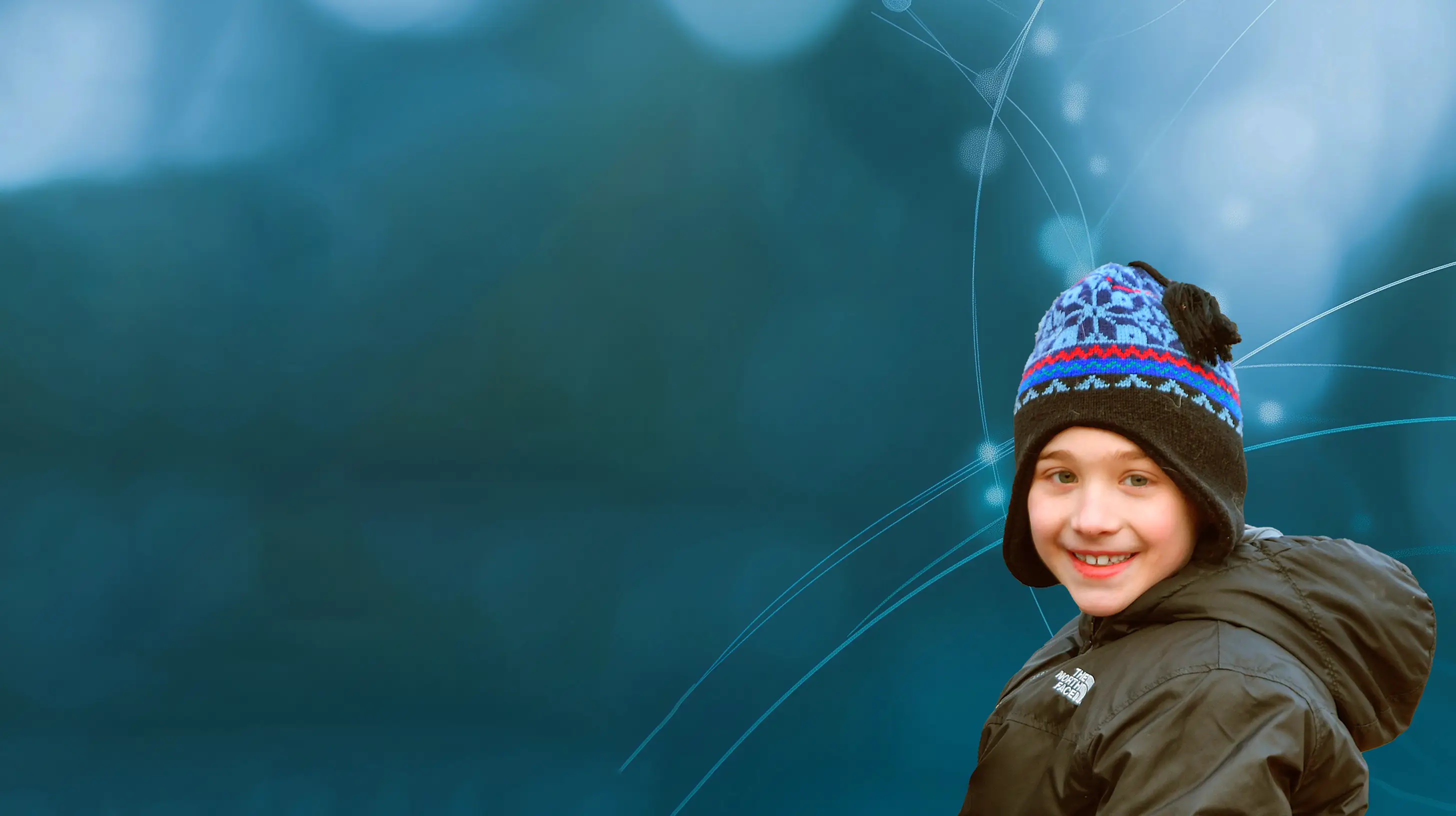
Before the trial. Before the device. Before the patient called CI3. There were three generations in a car driving to a hockey game.
This is the prologue · who Grandpa was, what he carried, and what he made possible.

Prologue
Before the trial. Before the device. Before the patient called CI3. There were three generations in a car driving to a hockey game.
This is the prologue · who Grandpa was, what he carried, and what he made possible.
Italian. Devout. Hard of hearing. The first person in Michael’s life to be unconditionally for him.
Before the trial, there was a man. Grandpa carried the hearing loss the family did not know it had. He passed it to one of seventeen grandchildren. He showed that same grandchild, by the way he lived, what it looked like to carry the loss without letting it carry you. The hearing loss and the example both arrived at the same address. The rest of this site is what the grandson did with them.
He didn’t listen to the radio. Music didn’t reach him the way it reached other people. But he didn’t sit in silence either · not with his grandson. He never wasted the time. He talked to Michael constantly. What he had to hand down, and what he handed down, were stories. Stories about growing up. Stories about his three children · Michael’s mother and his two uncles · when they were kids. Stories about his own earlier life. He held a room the way a seanchaí holds a room in the Irish tradition · a storyteller you cannot stop listening to · but he was Italian, and what he delivered was comedy. The expressions, the timing, the way he worded a moment for the moment. Side-splitting. Michael loved his stories. They were the way Grandpa kept the past in the room, and the way he kept the room together while he was in it.
Michael lived with his grandparents and his parents in his grandparents’ house until he was nine or ten. The backyard ran big and green. Rabbits crossed it at dusk, and when Grandpa was the one spotting them, he said what he always said the way he always said it. Out loud. Unembarrassed. With joy because there was joy in him, and love because there was love in him, and he never let the hearing loss pull either one down. “Hey Mike! Hey Mike! There’s Mr. Rabbit! You see Mr. Rabbit?! Hey Mr. Rabbit! Mr. Rab-bab-a-babbit!” He was talking to the rabbit. He was talking to the boy. He was strong in the understated way men of his generation were strong. Wrapped in care, in compassion, in joy. He never met a stranger. But God help the cashier who tried to sell him something he had not asked for.
He hated being upsold. Salesman, telemarketer, anyone trying to sell him something he hadn’t asked for · he had no patience for it. So when he and the boy stopped at a drive-thru after hockey practice one night, just the two of them, and Grandpa could not make out the tinny voice coming through the speaker, he ordered the way he always ordered: from memory, by guessing what the person was probably saying, and by sticking to what he knew he wanted. They pulled to the window and the young woman asked if he wanted tartar sauce. He thought she was upselling him. “No, I don’t want no pop tarts! I just want a fish sandwich and a chocolate milkshake!” Michael burst out laughing in the passenger seat. Grandpa caught the misfire and apologized right there at the window. Told her he didn’t hear well. Made a joke that had all three of them laughing before she handed him the bag. When Grandpa was wrong, he made amends right then. Michael learned that from him too. Michael told the team the next day, and from then until the end of his time on that squad, the boys would walk up to the stands and ask, “Hey Grandpa Seufer, want some pop tarts?” Grandpa would laugh with them. They loved him. He loved being part of it.
He went to every travel hockey game Michael played growing up. Every one. Three generations in the car: father, grandfather, the boy in goal. The teammates called him Grandpa Seufer. It wasn’t his last name. He was Michael’s mother’s father, a different surname entirely. He never corrected them. Not once. Being the boy’s grandfather mattered more than the surname.
The card came during preseason football conditioning at Ohio Wesleyan University, Selby Stadium, July heat, the week of Michael’s birthday. Grandpa signed it “From God and your #1 fan,” and meant both halves equally. It is the most treasured card Michael has ever received. Seven words that said how beloved Grandpa was to him and how beloved he was to Grandpa. There was nothing Michael could have asked of his grandfather that Grandpa would not have done. If he knew he could not do it, he would have tried to figure out how anyway. He loved his grandson through and through. That moment, in that stadium, will never leave Michael’s memory. It is stored in the most revered place there, for one of the most revered people who has ever been in it.
The loss does not soften. The man does not recede. What he gave outlived him by every measure that matters.
The hearing loss lived in Grandpa, passed to Michael, and stops there. None of Michael’s siblings carry it. None of his son’s generation does. None of the generations to come may ever have to. What Michael did at Mayo in 2022, he did for himself, for his son, for the patients who follow, and for the man who showed up to every rink and signed the card “From God and your #1 fan.” Michael tries every day to live up to the man Grandpa was, and to be the kind of dad to Mickey that Grandpa was to him. Grandpa would be damn proud of what his grandson is doing now. He was already damn proud back then.

Chapter One · The Story
Michael was implanted with the Envoy Medical Acclaim at Mayo Clinic on the afternoon of November 4, 2022. Two other patients were implanted in the same window. The three never met.
He is the only one of them who could use the device in its novel state. No hearing aid. No external hardware. What the clinical team observed in the post-activation room, by Michael’s account of being in it, was astonishment.
Three adults were selected for the FDA’s early feasibility study of the Acclaim. Two men, one woman. All three had lived for decades with bilateral sensorineural hearing loss. The trial was authorized as a first-in-human study; the device had never before been implanted in a human being. Michael Seufer was Patient CI3: the third, and as the published record would later document, the only patient to use the device as it was engineered to be used.
Michael is a single father from Columbus, Ohio. He has been an ice hockey goaltender his entire adult life. The hearing loss became apparent in second grade and undeniable by sixth, when his mother took him to an audiologist at The Ohio State University for testing. The audiologist, a man, was startled by the result. If the boy was earning A’s and B’s in school at his measured hearing loss level, the audiologist told Michael’s mother, your son must be a genius. By sixth grade Michael was reading at a verified college level and had been placed in Junior Great Books, the program for gifted and talented students. He borrowed The Hobbitfrom a math teacher and returned it three days later asking for the next book. By Michael’s own later account, what his brain was doing wasn’t intellect. It was already, at eleven years old, the beginning of forty years of cross-modal compensation: the neural reorganization that lets a partially-deaf cortex wring meaning from acoustic signal it shouldn’t be able to parse. With baseline word recognition at roughly ten percent even aided, the compensation was doing almost all of the work. As a teenager he was teased for the hearing aids, discarded them, and retreated. The compensation deepened anyway.
By the mid-2000s, in the office of his audiologist at Columbus Speech & Hearing, Michael pressed for a number. What percentage of people are capable of doing what you say I’m doing? Fifty? Twenty? Ten? The audiologist’s answer was on the record:
I have been doing this for twenty years and I have never seen someone do what you are doing, whatever it is. There is no explanation as to how you are getting the benefit from the hearing aids you are wearing, with the loss that you have.
The Acclaim trial, eighteen years later, is where the medical world acquired the instruments to record what that clinician had already told Michael to his face. The compensation she could not explain was not new in 2022. It was a forty-year head start.
What changed for Michael in 2022 wasn’t the science. It was his son. Mickey was nine years old. Michael had spent a lifetime missing pieces of every conversation, including conversations with his own boy, and he was done. In August 2022, he contacted Envoy Medical and Mayo Clinic about the Acclaim trial. Two weeks later he was at Mayo undergoing evaluation. On November 4, he was implanted by Dr. Colin Driscoll, MD, the trial’s senior surgeon, 27 years on staff. One month later, on December 5, 2022, the device was activated.
What Michael heard at activation was not what he expected. Sounds were chaotic, robotic, distorted. When Dr. Aniket Saoji, the trial’s lead audiologist, clapped his hands, Michael would later describe it as a racquetball sound, digitized. Voices were unintelligible. Expecting clarity, Michael was crushed. The clinical team consoled him and asked only that he track the implant’s battery life until his next visit.
He turned the implant off in the Mayo parking garage and returned to his AirBnB, relying on the hearing aid in his non-implanted ear. He didn’t sleep well. The next morning he began the fourteen-hour drive home to Columbus.
Before he was out of the Rochester city limits, Michael made a decision that no rehabilitation protocol had instructed him to make. He pulled the hearing aid out of his non-implant ear. He turned the implant back on. He opened his music playlist on his phone, called up the lyrics visually, used the bass line to find his place in each song, and began to sing along, forcing his brain to decode the implant’s distorted output with no fallback and no escape.
The first individual words began surfacing within thirty minutes of leaving the parking garage. Four hours later, by the time Michael was somewhere in Iowa, every word he spoke or sang was crystal clear. Four days later, back home in Columbus, all distortion was gone. Voices, music, environmental sound, all natural. The hearing aid stayed in a drawer.
Michael told no one at Mayo. The routine post-activation visit was already on the calendar. He drove the fourteen hours back to Rochester without sending a word ahead, without a portal message, without any hint that anything had changed. He wanted to walk into the appointment and surprise them. He wanted everyone in the room to be happy together.
Since that day in 2022, I have not used a hearing aid again.
The standard published trajectory for cochlear implant adaptation places functional speech-in-quiet recognition at three to six months post-activation, with music perception often taking a year or longer to approach pre-loss fidelity. Michael’s account places that arrival at four days. The peer-reviewed paper that followed the trial does not publish patient-by-patient adaptation timelines, but the existence of the paper, and the surgeon’s subsequent statement that Michael’s case was “critically important to the refinement of the device,” confirms what the clinical team observed in the room.
The mechanism, in clinical terms, is cross-modal plasticity at the outer edge of recorded human capability. Decades of decoding speech from a severely degraded acoustic signal had developed Michael’s auditory cortex into what amounts to a specialist decoder. When the Acclaim provided a signal, even a noisy one, the trained machinery engaged immediately. The drive home, by removing the hearing aid in his non-implant ear, eliminated competing input and forced the brain to commit. It is, in retrospect, exactly the kind of intensive, no-fallback rehab protocol an experimental neuropsychologist would design. Michael designed it for himself in the first hour of a fourteen-hour drive.
Adaptation timeline as documented in the Mayo Clinic post-activation session, December 19, 2022. Outcomes formally documented in Dornhoffer JR, DeJong MD, Driscoll CLW, Saoji AA. Early Hearing Outcomes and Audiological Experiences With a Novel Fully Implanted Cochlear Implant. Otology & Neurotology45(10):e727–e734, December 2024.
Chapter Two · The Impact
The implant’s circuit noise was not predicted before activation. It surfaced only once the device was on and turned up to a usable level. Two of three patients masked it with a hearing aid. One did not.
Patient CI3 was the only one running the Acclaim alone. Of the original three trial participants, he is the only one using the device entirely on its own, without the backup of a traditional hearing aid or any other external hardware. He could describe the noise because nothing covered it.
The published outcomes paper, in its 2024 conclusion, identifies a specific engineering challenge: “two of three [patients] use a hearing aid with their device to overcome unanticipated implant circuitry noise and achieve improved speech perception scores. Current work is focused on reducing this system noise to allow for the device to be used as intended, without a hearing aid.”
The two other patients in the early feasibility study, both long-time hearing-aid users, paired the Acclaim with their existing aids. The aid amplified incoming sound and sent it to the implant, which then operated at a lower volume than it would have required alone. With the volume lower, the circuit noise sat lower too. Functionally invisible. The patients carrying it weren’t in a position to describe it. The implant was working, but the trial’s premise · a fully implanted device used without external hardware · was being carried forward by one patient out of three.
Michael ran the device alone from the start. No hearing aid in either ear. Not at activation, not after, not since. He had decided on the drive home from Mayo, in December 2022, that his brain would learn to hear with the Acclaim and nothing else. He tuned the circuit noise out within about thirty minutes of any given listening session and stopped noticing it unless he turned his attention to it deliberately. He continued to characterize it for the team because he could. The other patients could not.
Across roughly two years of clinical sessions, from late 2022 into late 2024 and early 2025, the engineering team iterated on software and firmware fixes intended to reduce the noise without compromising sound quality. Each new build had tradeoffs. Some reduced noise but flattened tonality. Some improved clarity but introduced harshness or too much treble. Michael returned for session after session, listening to each version, describing what changed, what got better, and what got worse. The fix shipped at the end of 2024, into 2025. It is the product of many people and many iterations. Michael’s role was to be the one patient running the implant in its unaided state across every version, so the team had real-world feedback on what each change did when nothing was masking the result.
Four years later, he continues to use the Acclaim alone, without a hearing aid in either ear, with no external hardware of any kind. The same way he started.
The paper documents, across all three patients in the early feasibility study, the following observed outcomes: residual hearing in the implanted ear preserved through surgery; Type A tympanograms post-resolution of transient middle ear effusion; electrical stimulation levels comparable to traditional cochlear implants; average battery life of approximately four days; and improvement in quality-of-life metrics in two of the three participants.
What is specific to Patient CI3, and what the published record documents indirectly through the trajectory of the device’s refinement, is that the engineering challenge the paper names was characterized through one patient’s sustained unaided use and detailed clinical feedback. The device works as designed today because one patient could tell the engineers what the noise sounded like.
Three years later, in May 2026, on his retirement after 27 years at the Mayo Clinic, Dr. Driscoll wrote to Michael directly:
A special ‘thank you’ for being a pioneer in the development of the Envoy Acclaim cochlear implant and for the trust you placed in me and the Mayo Clinic team. You played a critically important role in the refinement of the device, it could not have been done without you.
Surgeon’s statement from the personal letter written by Dr. Colin Driscoll, MD on the occasion of his retirement from Mayo Clinic, published in full on this site on May 11, 2026 with explicit permission.
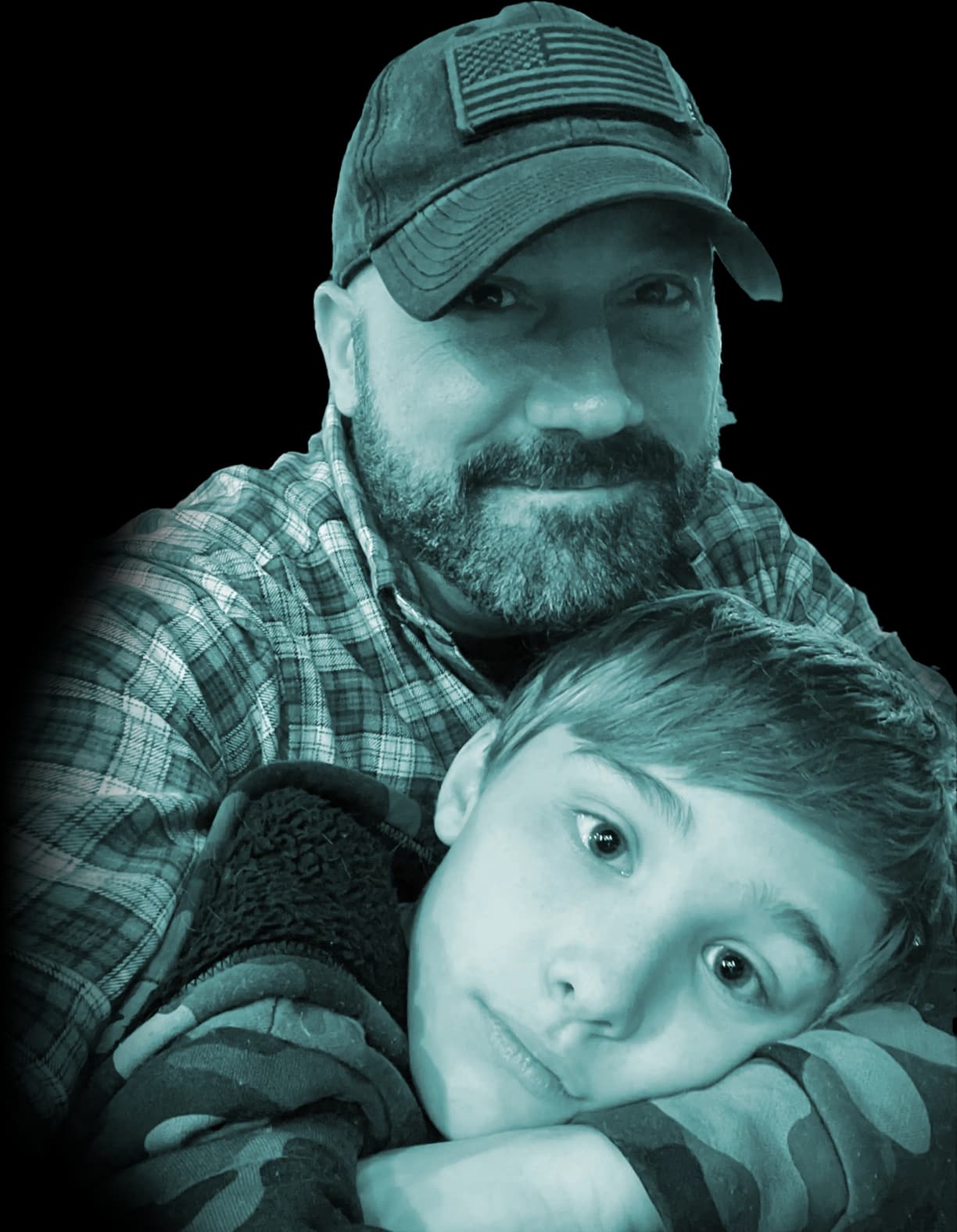
Driven by love. Powered by
Everything that follows in this chapter follows from this photograph.
The reason Michael agreed to the trial. The voice the implant was meant to hear.
Mickey turned fourteen on March 15, 2026. He is the reason Michael applied to Envoy Medical and Mayo Clinic in August 2022, and the reason Michael drove fourteen hours back from Rochester with the hearing aid out and the implant on, training his brain at seventy miles an hour. The implant was never about Michael’s ear in the abstract. It was about a specific boy and a specific voice and what had been lost between them.
He is, in Michael’s telling, a mercyheart. Caring in a way that does not advertise itself. Empathetic past his years. Selfless. He doesn’t ask for much. He’s mild-mannered, obedient when obedience is asked of him, and easy with other kids. He plays summer baseball and is looking to start hockey this fall, late but undeterred. He gets good grades. He loves his computer and gaming the way fourteen-year-olds do, and he loves the things his dad shows him that aren’t on a screen. Babybel Burgers in the kitchen. Adventure trips to a park or a scenic overlook. Dairy Queen. The knots Michael uses for camping. Bushcraft cooking. How to build a fire from nothing. Boy stuff, taught by a father who is, at fifty-four, still a big kid himself.
Before the implant, the car rides cost them the most. Mickey knew his dad couldn’t hear, and a kid doesn’t need to be told twice that the line between his mouth and his father’s ears is broken. He would try to talk. Michael would stop him and ask him to repeat himself. Or worse, Michael would answer something Mickey hadn’t actually said, and Mickey’s face would do the thing kids’ faces do when the adult in the room has missed them again. Disappointment the boy was too kind to name. Over time, Mickey all but gave up trying to talk to his dad in the car. A boy learns where the wall is. He stops walking into it.
What he never gave up on was wanting to show his dad things. That is the part of him that the hearing loss never managed to take. The look-at-me-dad moments. The thing he had just learned, the thing he could now do, the small accomplishment he wanted witnessed. He came to Michael with those over and over, year after year, no matter how many car rides had ended in confused looks. That is who Mickey is. The boy who keeps showing up, even after he’s stopped expecting a clean answer back.
The wall is gone now. There is no single dramatic moment that marks its absence, because the absence itself is the point. A father and a son in a kitchen, making Babybel Burgers together, having a normal conversation. Michael not interrupting to ask his son to repeat himself. Michael hearing the tone in his son’s voice. That is the answer to four decades of questions. That is what the trial was for. Not the headline, not the paper, not the pioneer language. A kitchen. A fourteen-year-old. A conversation that ran on its own.
Michael’s career would have been best served by moving out of state · DC, northern Virginia, the Gulf Coast, somewhere with a federal or military footprint that pays accordingly. He didn’t go. Mickey was at the age where leaving was not a choice Michael was willing to make. Daily purpose outranked the bigger paycheck and the better office. The career will catch up, or it won’t. The boy is fourteen exactly once.
Grandpa did not get to hear the way the grandson now hears. The grandson did not get to hear the way his own son will. Michael tries every day to be the dad to Mickey that Grandpa was to him. The arithmetic of the family ends not with what was lost, but with what gets handed forward instead.
The Envoy Medical Acclaim remains an investigational device, limited by federal law to investigational use until approval. The early feasibility study’s current enrollment phase has closed; the work now is data analysis and the preparation of the regulatory path that follows. The engineering refinements that came out of the trial are folded into the device today. The patients who follow, in this trial and the trials after it, will eventually hear with a fully internal cochlear implant requiring no external hardware, no hearing aid, no nightly removal, no interruption between waking and sleeping. The device working as it was engineered to work.
The line that opens what comes after, in Michael’s own life, is the founding of the Aurwell Foundation, an Ohio non-profit registered in his name and named for the work to come. Aurwell’s mission is to serve the everyday people, first responders, veterans, and law enforcement officers living with hearing loss. The population that has, for generations, lived with devices that worked imperfectly, partially, or not at all. The Foundation is in the process of filing its IRS 501(c)(3) determination at the time of this writing.
This site holds the record of what happened. The trial, the surgeon, the patient, the device, the bug, the iterations, the unaided hearing, the boy in the kitchen. It will hold the chapters yet to be written, in time.
In May 2026, three years after the implantation, on the occasion of his retirement after twenty-seven years at Mayo Clinic, Dr. Colin Driscoll, MD wrote to Michael directly. He gave explicit permission to publish his words in full:
A special ‘thank you’ for being a pioneer in the development of the Envoy Acclaim cochlear implant and for the trust you placed in me and the Mayo Clinic team. You played a critically important role in the refinement of the device, it could not have been done without you.
The Envoy Medical Acclaim is an investigational device, limited by federal law to investigational use. Trial details and device information are available at envoymedical.com/acclaim-cochlear-implant.